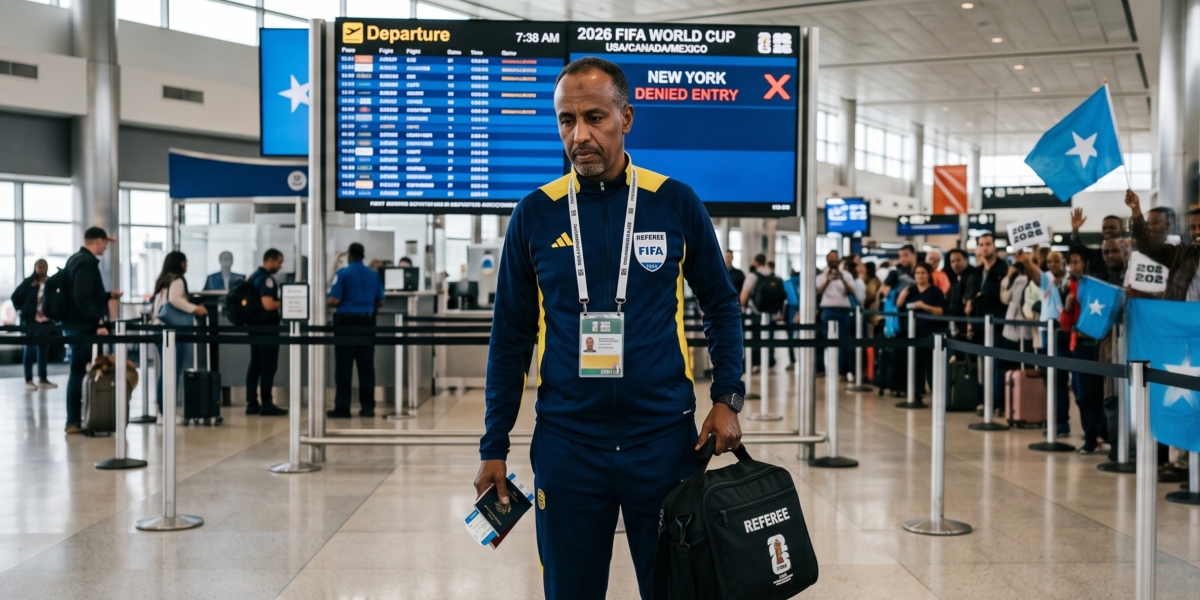
A major controversy has emerged ahead of the 2026 FIFA World Cup after Somali international referee Omar Abdulkadir Artan was denied entry into the United States despite being selected to officiate at the tournament.
The decision has sparked outrage across Somalia, as Artan was set to become the first Somali referee in history to participate in a FIFA World Cup.
Ad Slot – in_article
Who Is Omar Artan?
Omar Artan is widely regarded as one of Africa’s top football referees.
Over the years, he has officiated major continental competitions and earned international recognition for his performances.
His selection for the 2026 FIFA World Cup represented a historic achievement not only for him personally but also for Somali football as a whole.
What Happened?
According to U.S. authorities, Artan arrived at Miami International Airport from Istanbul and underwent additional screening procedures.
Following the inspection, officials determined that he was inadmissible due to what they described as “vetting concerns.”
Despite reportedly holding a valid visa, the Somali referee was denied entry and forced to abandon his World Cup assignment.
Somalia Responds with Frustration
The decision triggered strong reactions from Somali officials and football supporters.
Government representatives and sports authorities expressed disappointment, arguing that the ruling deprived Somalia of a historic moment on the global football stage.
Several officials called for greater transparency regarding the reasons behind the decision and described the situation as a major setback for Somali sport.
FIFA’s Position
FIFA clarified that immigration and visa decisions fall entirely under the authority of host governments.
The organization stated that it has no role in determining who is granted entry into a host country and confirmed that Artan’s status would not be changed.
A Historic Dream Cut Short
What makes this story particularly emotional is the significance of the opportunity.
Artan was on the verge of making history as the first Somali referee ever selected for a FIFA World Cup.
Years of dedication, hard work, and professional development had led to this moment.
For many Somali fans, the decision represents more than the exclusion of a referee—it symbolizes the loss of a national milestone.
A New World Cup Controversy
The incident has added to broader discussions surrounding travel restrictions, visas, and accessibility during the 2026 FIFA World Cup.
Observers argue that the success of a global sporting event depends not only on stadiums and infrastructure but also on ensuring equal participation opportunities for players, officials, and supporters alike.
Final Thoughts
Omar Artan’s World Cup dream has become one of the most talked-about stories ahead of the tournament.
As Somalia expresses its frustration and U.S. authorities defend their decision, the controversy continues to raise questions about the intersection of sport, immigration policy, and international competition.
Regardless of the outcome, Omar Artan’s story will remain a significant chapter in Somali football history.