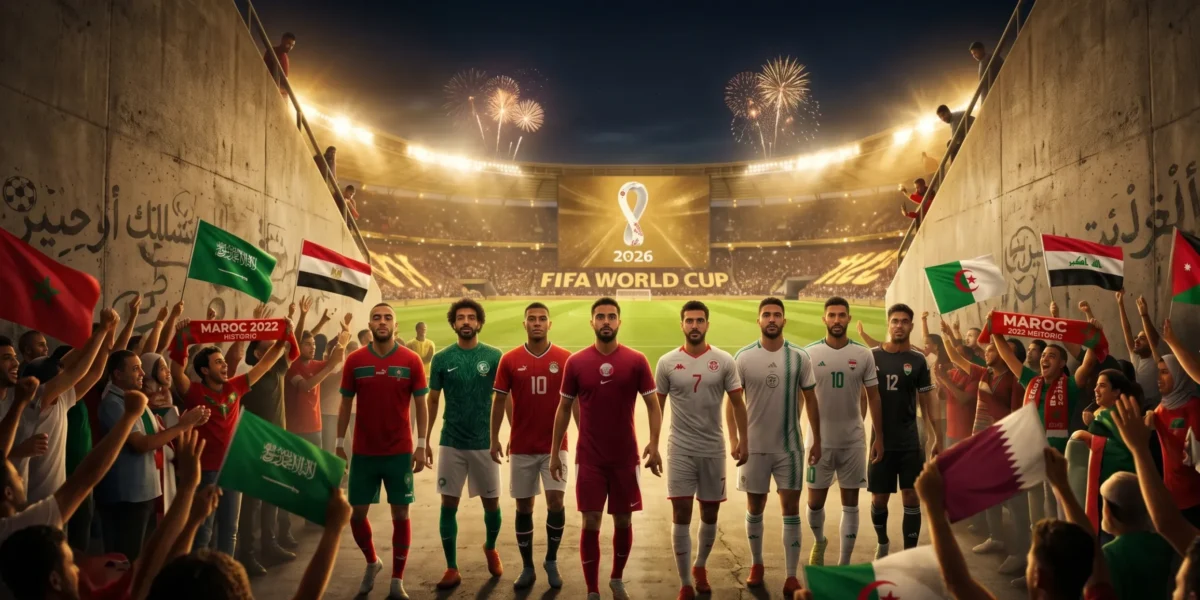
For decades, Arab national teams entered the FIFA World Cup with a simple objective: represent their countries proudly and, if possible, advance beyond the group stage.
But times have changed.
Following recent achievements and remarkable progress across Arab football, expectations are higher than ever before.
Ad Slot – in_article
As World Cup 2026 approaches, millions of fans are asking a bold question:
Can Arab nations break historical barriers and write a new chapter in football history?
Qatar 2022 Changed Everything
The 2022 FIFA World Cup marked a turning point for Arab football.
It demonstrated that Arab teams could compete with the world’s biggest football powers.
Morocco’s historic run to the semi-finals inspired an entire generation of players and supporters across the region.
For the first time, the dream no longer felt impossible.
Morocco Set a New Standard
When Morocco defeated some of the strongest teams in world football, perceptions changed forever.
The conversation shifted from simply participating to genuinely competing.
Suddenly, Arab football became associated with:
- Ambition
- Tactical excellence
- Discipline
- Historic achievements
And perhaps, one day, even winning the World Cup.
A Stronger Generation of Arab Players
The Arab teams preparing for World Cup 2026 are entering the tournament with greater experience and confidence than previous generations.
Many Arab stars now play for elite European clubs and regularly compete at the highest level.
This exposure has helped develop players capable of challenging the world’s best teams.
Fans Expect More
In the past, qualification alone was considered a success.
Today, expectations are very different.
Supporters want to see Arab teams compete fearlessly against football giants such as:
- Brazil
- Argentina
- France
- Spain
- Germany
The mentality has evolved from participation to ambition.
Can History Be Rewritten?
History is not always permanent.
If Qatar 2022 taught football fans anything, it is that modern football rewards organization, teamwork, belief, and preparation.
The gap between traditional powers and emerging nations is becoming smaller.
As a result, many analysts believe World Cup 2026 could deliver another major Arab breakthrough.
Why 2026 Could Be Different
For the first time, the World Cup will feature 48 national teams.
The expanded format provides additional opportunities for Arab nations to qualify and progress deeper into the competition.
Combined with the experience gained over recent years, many believe the conditions are ideal for another historic achievement.
Final Thoughts
Arab football enters World Cup 2026 with a completely different mindset.
The objective is no longer just participation.
The goal is to compete.
To inspire.
And perhaps, to make history once again.
Can Arab teams challenge football’s established order?
The answer will be written on the pitches of the United States, Canada, and Mexico.
And the entire world will be watching. 🌍🏆⚽